.
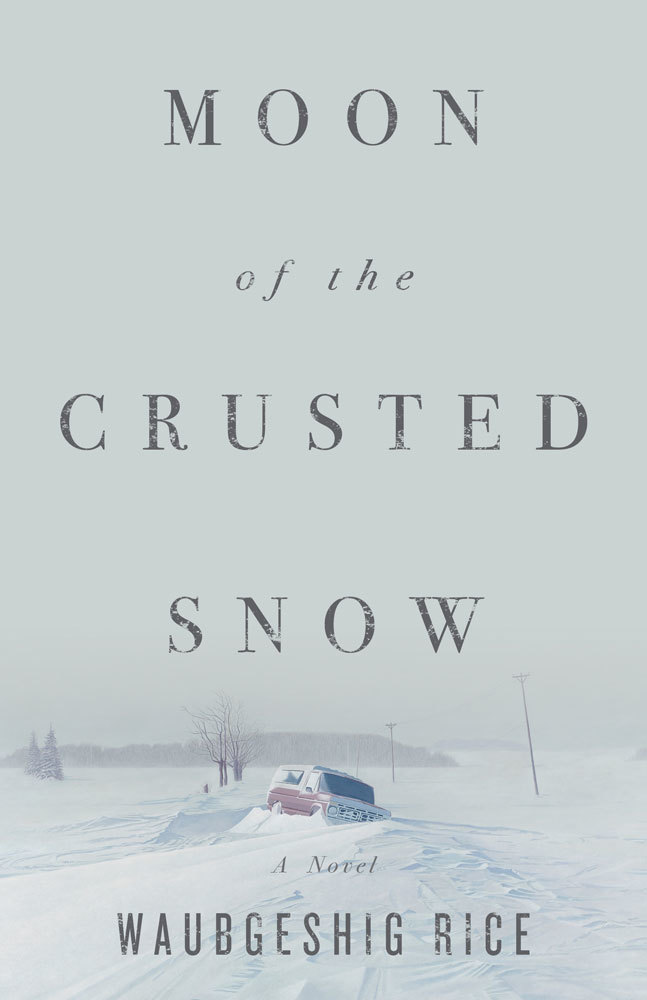
Moon of the Crusted Snow
by Waubgeshig Rice
220 Pages || Published October 2nd, 2018 || ECW Press
.
Moon of the Crusted Snow is a dystopian novel set in a close-knit Anishanaabe reservation in northern Turtle Island [what we commonly refer to as Canada] as they find themselves cut off from the rest of the world, for good or ill. Filled with unique personalities, this book explores how this community comes together to survive the winter without the comforts to which they had become accustomed. Even as they gain a fuller awareness of the situation “down south,” the community is confronted with an outsider who seeks to share in their limited resources. As this man continues to cause problems big and small, Evan Whitesky steps up to lead the community out of the devestating winter.
I read this book on a snowy Sunday as the world blanketed itself around me in white. The mood for this book was set by my own evironment and I could imagine what it would be like to be cold and isolated in the deep winter, as the characters of this novel find themselves. This book meanders through the reservation and Evan Whitesky’s life for most of the first half of the book, allowing the reader to become acquainted to the environment and the people that make up the heart of this story. These are a people who have done without for much of their recent history, and as such are prepared to do without now. The effects of colonization have taken its toll, though, and some are more prepared than others to return to older modes of living. I appreciated this first hand look into what colonization has taken from the First Nations people. This quote, perhaps a little further than halfway through the book, caught my attention:
Apocalypse?”
Moon of the Crusted Snow, page unknown
“Yes, apocalypse! What a silly word. I can tell you there’s no word like it in Ojibwe. Well, I never heard a word like that from my elders anyway.”
Evan nodded, giving the elder his full attention.
“The world was ending,” she went on. “Our world isn’t ending. It already ended. It ended when the Zhaagnaash came into our original home down south on that bay and took it from us. That was our world. When the Zhaagnaash cut down all the trees and fished all the fish and forced us out of there, that’s when our world ended. They made us come all the way up here. This is not our homeland! But we had to adapt and luckily we already knew how to hunt and live on the land. We learned to live here!”
She became more animated as she went on. Her small hands swayed as she emphasized the words she wanted to highlight. “But then they followed us up here and started taking our children away from us! Thats when our world ended again. And that wasn’t the last time. We’ve seen what this….what’s the world again?”
“Apocalypse.”
“Yes, Apocalypse. We’ve had that over and over. But we always survived. We’re still here. And we’ll still be here, even if the power and the radios don’t come back on and we never see any white people ever again.”
There is nothing magical about this book. By that I mean this is no fantasy, no sci-fi, so supernatural horror. These are all the things to which I usually gravitate. In all honesty, I had no idea what this book was about when I decided to read it, as is my standard modus operandi. I have a tendency to use a synopsis more after the fact than beforehand, a practice helped along by the fact that they are often missing on book jackets these says in favor of review blurbs. I knew two things about this book before I checked it out from the library: it was dystopian, and it was indigenous. I don’t read much contemporary fiction, but when I do, it does tend to be by authors indigenous to Turtle Island. Due to this fact, Anishanaabemowin is becoming familiar to me. I want to express my gratitude to these writers, specifically Rice, Angeline Boulley, and my queen, Robin Wall Kimmerer, for sharing their stories and their language with all of us. So while there is nothing magical about this book, this book is made magical to me through the sharing of culture that it represents. That was my real takeaway from this slow-building book. Chi-miigwech, Waubgeshig Rice!
Despite knowing not really anything about this book, I had noticed that Storygraph had labeled this book as a thriller. I haven’t read many thrillers. Indeed, I was never really interested in being scared by the books I read until I began reading Stephen Graham Jones [again, picked up My Heart is a Chainsaw based solely on the cover and title. Probably should have realized it was a horror novel at the time, but I am who I am, so..]. Looking back through my Storygraph at books I have read that had been listed as thrillers, I wonder if I actually know what a thriller is. I had envisioned, as the word suggests, something that causes great emotion and anxiety as it is consumed, but apparently it is just that the book has crime? There was a certain amount of suspense, most of which continues since we do not have any indication of what happened to cause the complete and total collapse of society, but not the kind of suspense I had been taught to anticipate in movies of the thriller genre [not that I’ve seen all that many, in thruth]. This is possibly a failing on my own part. As a writer and someone who has read at least a thousand books in faer life, I often see things coming very early on. The emotional climax of Evan dealing with Scott at the end of the book did not take me by surprise, but it is no less meaningful. The way it ended was how it always had to end, though I was surprised by the precise mechanisms. It made sense, and yet still I was a little surprised that Whitesky didn’t take as active of a role as a character that we knew precious little about.
Fear can make us do and be all kinds of things. The primary function of fear is to keep us all separated from each other, to see the other as less than ourselves. There is a moment in this book, one filled with fear and trepidation that is made worse by Scott’s unasked for actions. It was notable to me that the leader in Whitesky, though hesitant, had never intended to send the hungry escapees of the apocalypse out into the cold to survive or die as they would. Wouldn’t it be nice to live in a world where our leaders approach fear with caution and compassion?
I don’t know how much of a traditional review this is or if I’m just blogging about this book I read. I’m in week 4 of the Artist’s Way so I can’t check to make sure that I am hitting all the benchmarks of a review, but in truth, I don’t know how much it matters.
I enjoyed this book. It was not the greatest thing I have ever read, but it is well worth a read, especially for people who want a good look at Anishanaabe culture or like a quick little dystopia. The sequel, Moon of the Turning Leaves, is coming out in February of this year, so now would be a great time to read this book.
You can check out more from Waubgeshig Rice on his webiste: https://waub.ca/
 The Druid Scholar