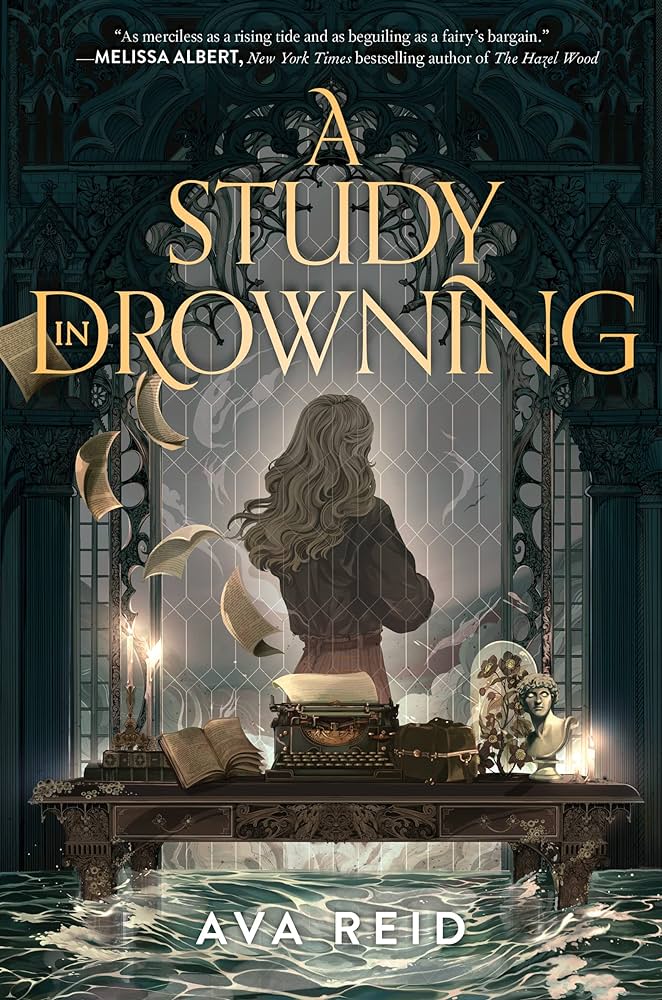
Literature has the power to make us feel seen, soothe our aching hearts, and inspire us to achieve better for ourselves. For Effy Sayre, the stories of Emrys Myrddin were a lifeline in a world that refused to acknowledge her truths, not least of which that she was promised to the Fairy King. As an architecture student at the most prominent university of Llyr, she was perfectly positioned to take up the opportunity to redesign the Myrddin family estate, Hiraeth Manor, following the author’s death. Her stay at Hiraeth turns out to be wildly different from what she had expected. The house is sinking into the sea, she is forced to stay in a guest cottage, and an insufferable literature student, Preston Heloury, is trying to ruin the legacy of her hero. Battling misogyny and supernatural forces, Effy and Preston uncover the truth, setting right the literary legacy of Llyr.
This book relies heavily on Welsh history and folklore. In my reading of A Study in Drowning, Effy Sayre reminded me of the Lady of the Lake, a powerful figure in Arthurian Lore which receives nods throughout the work. Water is a theme throughout Reid’s book. Myrddin died by drowning, Hiraeth is sinking into the sea, leaky, and is often moist in a way that is stagnant and dead, as is Myrddin’s son Ianto. The very beginning of the book (as I recall it at least, as I do not have a physical copy to look at), requests of the reader to consider the relationship between women and water.
“When men fall into the sea, they drown. When women meet the water, they transform. It becomes vital to ask: is this a metamorphosis, or a homecoming?”
Even the phrasing of this line is interesting to me. Men “fall” while women “meet.” This suggests that men are passive or lacking in agency while women are engaging and intentional. [Notice, I did not say “active.”] Water is many things here, but this makes me think of what water represents in the Tarot: relationships and emotions. Often, our culture of toxic masculinity keeps men from “meeting” or engaging with others on a deep level, something that is somewhat expected of women. I don’t want to discuss too much what this book says about men, because this book is not really ABOUT men. This book is about what it means to be a woman.
I recognized myself and every assigned at birth and self-identifying woman I’ve ever known in these pages. Effy, as the only girl in the Architecture program (because women are not permitted to study literature as their minds are not up to the task) is singled out for harassment and abuse by her peers, her advisor, and the university-at-large. She is a topic of conversation, blamed for the sexual abuse that happened to her (which is not blatant on the page, for those in need of a content warning) to the point that even people outside of her course of study have heard about it. This is what I think of when I consider how Effy comes to “meet the water.” I don’t think I can discuss it without spoilers because frankly, this book is about just that. Handling trauma, defeating your demons, overcoming the expectations others force upon you without your consent.
Indeed, the wider world that can be seen here is one that praises the man and denigrates the woman, evident in the quote: “I was a woman when it was convenient to blame me, and a girl when they wanted to use me.” This sentiment is reflected in so many aspects of society today including not just how we discuss femmes, but how we discuss people of color and victims of violence [see: the news calling literal single digit Palestinian children “young ladies” when they are murdered by soldiers].
Other conflicts are mentioned, somewhat less satisfactorily as one reviewer I read pointed out, that are related to the world we experience daily. Specifically, colonization and nationalism. As these topics are not the focus of this work and would likely detract from the tightness of the rest of the narrative, so I’m ok with how Reid chose to broach these topics. Unlearning colonialist, nationalist sentiment takes a lot more work and time than this novel contained within it. I think it is fair to have Effy end her story without necessarily coming out with a whole new perspective on something she thought she knew her entire life after having a relationship with one person. That legacy serves a purpose in this story, namely to have a way for Preston to have also experienced being othered, and to provide Effy with a viewpoint that she couldn’t have had on her own. I appreciated the call outs in mindset, and I don’t know that the work would be much improved by delving more into that realm of thought, though I would love to be proven wrong.
This was the first book I ever read by Ava Reid, and it won’t be the last. I enjoyed this expertly crafted book immensely.
You may like this book if you enjoyed Ninth House by Leigh Bardugo, and if you enjoyed this book you may enjoy To Shape a Dragon’s Breath by Moniquill Blackgoose.
 The Druid Scholar